
Thermal + Field Verification
Moisture Surveys
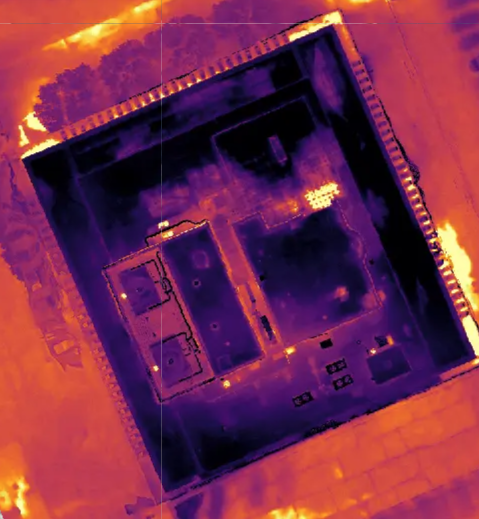
See patterns a visual roof walk alone may not reveal.
Thermal imagery, moisture impedance, roof history, and field verification can help identify areas that warrant closer investigation before major roofing decisions are made.
WHAT YOU RECEIVE
Decision-ready information, organized for the next step.
Thermal imagery, moisture impedance, roof history, and field verification can help identify areas that warrant closer investigation before major roofing decisions are made.
✓Thermal drone data collection when conditions allow
Why this matters +
Are the weather, roof construction, and timing suitable for useful thermal data?
How we helpThermal capture is planned around roof type and environmental conditions so temperature patterns have a defensible investigative purpose instead of simply producing impressive imagery.
Read the related owner guide →✓Visual drone documentation and orthomosaic mapping
Why this matters +
Can a thermal pattern be tied back to an exact visible roof location?
How we helpVisual mapping gives the thermal survey roof-wide location context so suspected areas can be revisited, verified in the field, measured, and communicated clearly.
Read the related owner guide →✓Impedance or capacitance screening where appropriate
Why this matters +
Can a second non-destructive method support—or challenge—the thermal interpretation?
How we helpWhere the roof assembly supports it, impedance or capacitance screening can provide another line of evidence before more invasive verification locations are selected.
Read the related owner guide →✓Targeted verification-point strategy
Why this matters +
Where should verification be performed to answer the moisture question efficiently?
How we helpWe use imagery, roof construction, leak history, and screening results to target representative and suspicious areas instead of treating destructive verification as random sampling.
Read the related owner guide →✓Suspected wet-area mapping
Why this matters +
How much roof area appears to warrant verification, and exactly where is it?
How we helpSuspected patterns are mapped as investigation targets with location and area context while remaining clearly distinguished from moisture that has actually been field-verified.
Read the related owner guide →✓Decision support for repair, restoration, or replacement
Why this matters +
Does the verified moisture condition change which roofing options are still responsible?
How we helpMoisture extent, construction, condition, and repairability help determine whether localized repair, restoration, recover, or replacement remains technically and financially reasonable.
Read the related owner guide →HOW IT WORKS
A clear path from project question to usable output.
01Plan
Review roof type, weather requirements, known leaks, building operations, and the decision being supported.
Why this step +
Plan
Review roof type, weather requirements, known leaks, building operations, and the decision being supported.
Review roof type, weather requirements, known leaks, building operations, and the decision being supported.
Read the related owner guide →02Collect
Capture visual and thermal data under appropriate environmental conditions.
Why this step +
Collect
Capture visual and thermal data under appropriate environmental conditions.
Capture visual and thermal data under appropriate environmental conditions.
Read the related owner guide →03Verify
Compare imagery with field observations and selected moisture-screening or verification methods.
Why this step +
Verify
Compare imagery with field observations and selected moisture-screening or verification methods.
Compare imagery with field observations and selected moisture-screening or verification methods.
Read the related owner guide →04Interpret
Report findings with method limitations, suspected patterns, priorities, and recommended next steps.
Why this step +
Interpret
Report findings with method limitations, suspected patterns, priorities, and recommended next steps.
Report findings with method limitations, suspected patterns, priorities, and recommended next steps.
Read the related owner guide →COMMON QUESTIONS
What owners usually want to know first.
Does thermal imaging prove insulation is wet?
No. Thermal imagery identifies temperature patterns that may warrant field verification. Interpretation depends on roof construction, weather, surface conditions, and the selected method.
Will this work on every roof?
No. Some roof types, coatings, metal systems, ballast, weather conditions, or access limitations can reduce effectiveness.
Can a moisture survey help determine restoration suitability?
It can provide important evidence, but final restoration suitability may also require manufacturer review, adhesion testing, destructive testing, or design input.
ROOF INTELLIGENCE KNOWLEDGE CENTER
Not ready to schedule? Start by asking better questions.
Use our owner-focused guides to understand moisture surveys, repair versus restoration versus replacement, contractor proposals, lifecycle planning, maintenance, warranties, drone data, and capital decisions.
NATIONAL REACH. OKLAHOMA ROOTS.
Need this information for a real building?
Start with the property, the roof question, and the decision you are trying to make.
Schedule a Roof Evaluation